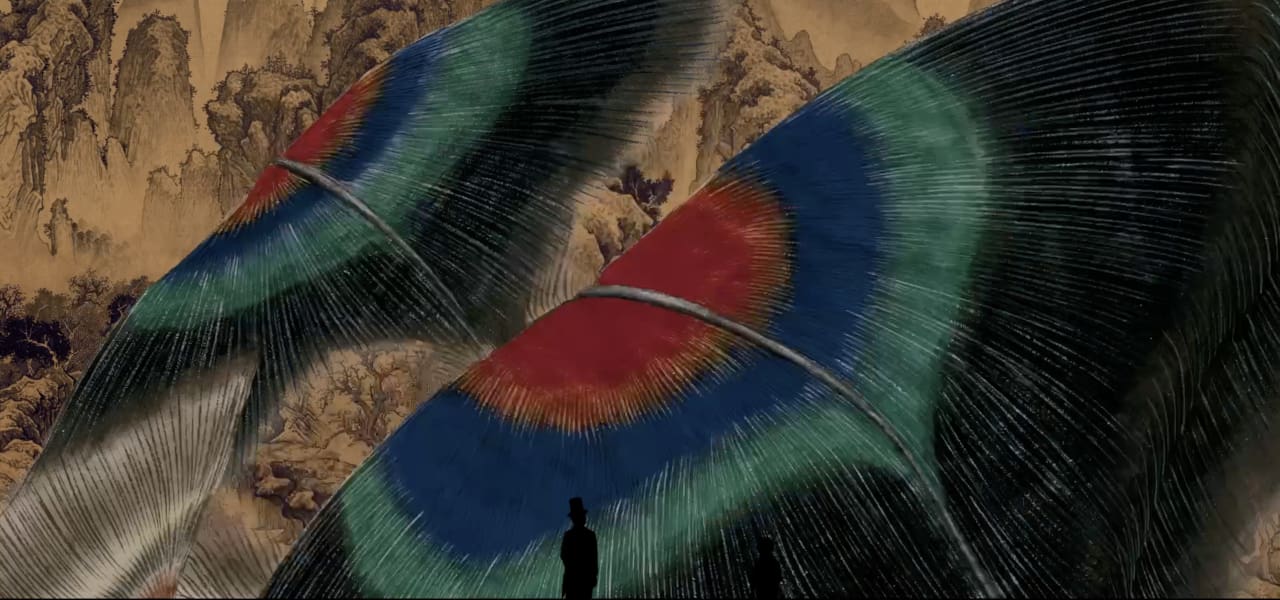
Sun Xun's upcoming animated feature, 'Magic Atlas,' is a decade-long labor of love and a true artistic endeavor. This film, set to premiere at the Locarno Film Festival, is an ambitious and unique project that challenges conventional narrative structures.
What makes 'Magic Atlas' particularly intriguing is its complex blend of spiritual themes, political commentary, and folk tales. The story follows a young apprentice, Xiaozhi, who embarks on a journey through different identities and realms, guided by a magical star atlas. Among these realms is Luocha, a coal empire devoid of history and memory, a stark reminder of the consequences of exploitation and control.
Sun Xun, primarily known as a gallery artist, has delved into the world of animation with a unique perspective. His background in painting and contemporary art is evident in the film's visual language, which seamlessly transitions between woodcut animation, ink painting, and Persian miniature. This fusion of styles creates an intricate cosmology, exploring power dynamics, reincarnation, and the quest for self-discovery.
The production of 'Magic Atlas' was an epic undertaking, involving a small core team and an impressive 500 art-school students. Sun Xun's approach to funding was unconventional, relying on sales of his artwork to finance the project. This method allowed for a gradual assembly of the film, but it also presented challenges, especially during the COVID-19 pandemic, which disrupted the project's progress and funding sources.
One of the key practical challenges was the use of woodcut animation, a technique that required extensive training and collaboration. Sun Xun's suspicion of standardized animation styles, particularly the influence of Japanese animation on Chinese animation, led him to explore a more diverse and risk-taking approach. He believes that art, and animation specifically, should embrace uncertainty and take risks to progress.
The film's narrative is intentionally complex, leaving room for interpretation and personal connection. Sun Xun encourages viewers to engage with the work on a sensory level, emphasizing feeling over understanding. He compares this experience to falling in love, where uncertainty and the unknown can be romantic and beautiful.
'Magic Atlas' also delves into political themes, presenting Luocha as a metaphor for oppressive regimes. Sun Xun suggests that politicians and historical narratives often conceal their deceptions, but the magician in his work is a 'legitimate liar,' whose dishonesty is an open secret. This character represents the potential for art to reveal truths and create openings in accepted realities.
The film's final sequence, a burst of color in an otherwise monochromatic world, serves as a powerful reminder of the vitality and importance of art. Sun Xun's work challenges viewers to be vigilant and skeptical, to recognize the presence of art, and to appreciate the texture of life it brings.
In conclusion, 'Magic Atlas' is a testament to Sun Xun's artistic vision and his belief in the power of animation to explore complex themes. It is a film that invites viewers to embark on a spiritual and philosophical journey, offering a unique and thought-provoking experience.